Product Updates
The Longevity Lever: Sleep Consistency
Author:
Athena
Feb 19, 2026
The Longevity Lever Almost No One Talks About: Sleep Consistency
When people decide to improve their health, they usually focus on the big, visible levers. They commit to exercising more. They clean up their diet. They promise to sleep at least seven or eight hours a night.
But there’s a powerful variable that rarely gets the same attention — and it may be just as important as sleep duration itself.
Sleep consistency.
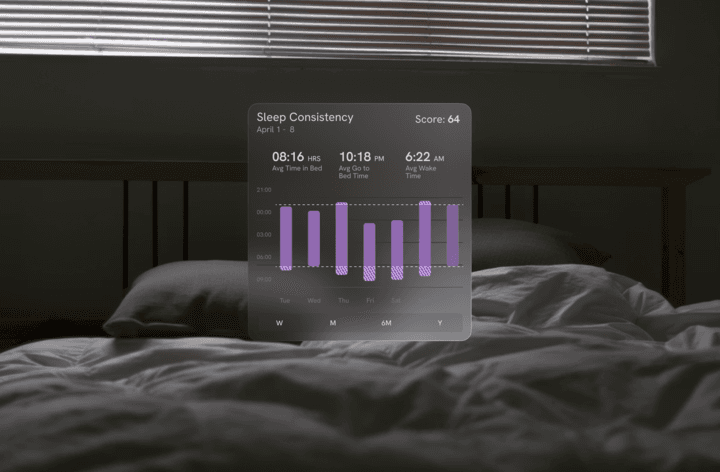
Not just how long you sleep. Not just how high your sleep score was last night. But whether you go to bed and wake up at roughly the same time every day.
It sounds simple. Almost too simple.
Yet sleep consistency may be one of the most overlooked, highest-return health behaviors available — especially if your goal is long-term vitality and longevity.
Your Body Runs on Timing, Not Just Sleep
Inside your brain sits a small cluster of neurons that functions as your master clock. This clock coordinates a 24-hour rhythm that regulates nearly every system in your body. Hormones rise and fall on schedule. Body temperature fluctuates predictably. Blood pressure follows a daily pattern. Even how your cells process glucose depends on the time of day.
When you maintain consistent sleep and wake times, that internal clock runs smoothly. Signals are sent at the right times. Hormones pulse when they’re supposed to. Repair mechanisms activate on schedule. Improving sleep consistency does not require perfection. Even maintaining a relatively stable bedtime and wake time — within about 30 to 60 minutes — can significantly support circadian balance.
But when your sleep schedule shifts frequently — staying up late on some nights, sleeping in on others — your body experiences a mild but chronic form of jet lag. Even if you are technically getting enough total sleep, the rhythm itself becomes unstable.
And rhythm matters.
Why Consistency May Matter as Much as Duration
Two people can both average seven and a half hours of sleep per night. On paper, they look identical.
But if one person goes to bed and wakes up at consistent times, while the other shifts their schedule by one to three hours throughout the week, their biology will not look the same.
Irregular sleep timing has been associated with poorer glucose control, higher resting heart rate, increased inflammation, and greater cardiometabolic risk. Some studies suggest that sleep variability — independent of total sleep time — is linked to increased risk of metabolic syndrome and cardiovascular disease.
In other words, it’s not just how long you sleep. It’s how predictable your sleep is.
Your body thrives on signals it can anticipate. Predictability strengthens those signals. Irregularity creates biological noise.

What Happens Inside the Body
When sleep timing is consistent, the body’s internal systems become more stable and efficient. Hormonal rhythms align so that cortisol rises predictably in the morning to promote alertness, while melatonin increases at night to prepare the body for rest. During deep sleep, growth hormone is released more effectively, supporting tissue repair, immune recovery, and metabolic health.
Consistent sleep also improves insulin sensitivity and glucose regulation, helping the body manage energy more efficiently. Appetite-regulating hormones like leptin and ghrelin function more predictably, which can influence hunger, weight stability, and overall metabolic balance. Cardiovascular health benefits as well, as regular sleep schedules are associated with healthier blood pressure patterns, lower resting heart rates, and reduced strain on the nervous system.
The brain is equally affected. Stable sleep timing supports memory consolidation, emotional regulation, focus, and executive function, while irregular schedules are linked to greater fatigue, mood volatility, and reduced cognitive clarity. Over time, maintaining consistent sleep timing strengthens recovery, improves resilience to stress, and helps the body more effectively repair, restore energy, and prepare for the demands of the next day.
The Longevity Connection
Longevity is not the result of a single heroic intervention. It is the cumulative effect of small, repeatable behaviors that reduce stress on the body over decades.
Chronic circadian disruption has been associated with increased risk of cardiometabolic disease, neurodegenerative conditions, and systemic inflammation. Shift workers, for example, often show higher rates of metabolic and cardiovascular disorders, likely due in part to persistent circadian misalignment.
Sleep inconsistency, even in less extreme forms, can mimic a milder version of this disruption. Over time, that subtle strain compounds.
By contrast, consistent sleep strengthens the body’s natural repair cycles. It allows the cardiovascular system to follow predictable recovery rhythms. It supports glymphatic clearance in the brain — the process by which waste products are removed during deep sleep. It reinforces hormonal balance and metabolic stability.
The effects may not be dramatic overnight. But over ten, twenty, or thirty years, the compounding impact is meaningful.
Why We Overlook It
Sleep duration is easy to track. Apps highlight it. Devices score it. “Eight hours” is a clean goal.
Consistency is less glamorous. It requires discipline, especially socially. Many people experience “social jet lag” — staying up late on weekends and sleeping in, only to struggle Sunday night and drag through Monday morning.
That cycle feels normal because it’s common. But biologically, it’s disruptive.
The irony is that improving sleep consistency often requires less effort than trying to extend sleep duration dramatically. It doesn’t demand supplements, specialized equipment, or elaborate biohacks. It requires rhythm.
And rhythm is free.
How to Build Consistency Without Overcomplicating It
The most powerful step is anchoring your wake time. Waking at roughly the same time each morning — even on weekends — stabilizes your circadian rhythm more effectively than obsessing over bedtime. When your wake time is consistent, your body begins to feel sleepy at a predictable hour naturally.
Morning light accelerates this process. Exposure to natural light within the first half hour of waking sends a strong signal to your brain that the day has begun. This strengthens the timing of melatonin release later that night, making it easier to fall asleep on schedule.
Creating a simple wind-down routine can also reinforce predictability. Dimming lights and reducing stimulating input in the final hour before bed allows your nervous system to transition smoothly into sleep mode. The routine does not need to be elaborate; it needs to be repeatable.
Perhaps most importantly, minimizing weekend drift matters. Shifting your schedule by two or three hours may seem minor, but biologically it is significant. Keeping weekend wake times within an hour of your weekday schedule preserves rhythm while still allowing flexibility.
None of these changes require perfection. They require intention.
The Performance Dividend
For those focused on training and performance, sleep consistency is a quiet multiplier. Stable sleep timing improves recovery, supports heart rate variability, lowers resting heart rate, and enhances adaptation to training stress. Athletes train with consistency because adaptation depends on repeated, predictable stimulus. Your nervous system operates the same way.
Consistency builds resilience.
If you care about performance, consistency improves it.
If you care about longevity, consistency protects it.
Health is rarely built through dramatic gestures. It is constructed through behaviors that are sustainable and repeatable.
Sleep consistency may be one of the highest-return habits available.
Predictable sleep strengthens predictable biology. Predictable biology is resilient biology. And resilience — the ability to recover, adapt, and endure — is at the core of long-term health.
The question is no longer just how long you sleep.
It’s whether your body can rely on when you sleep.
And that may be one of the simplest longevity levers you can pull.